
What Is Hard Money Lending? A Guide for Long Island Investors
Hard money is a loan secured by real estate instead of your credit score or income. A private lender funds the deal based on the property's value and the numbers behind it, not on how much you personally make or owe. That's the short version. Here's what it actually means for you as a Long Island investor.
How Hard Money Actually Works
A bank looks at you first and the property second. Hard money flips that order.
When Equiquest underwrites a loan, the property is the focus. We look at what it's worth now, what it'll be worth after the work is done, and whether the plan to fix and sell (or refinance) actually makes sense. Your credit history matters less than whether the deal itself holds up.
This is the part that trips people up the most. If you've been holding off on investing because you think you need a six-figure bank account or a spotless credit report first, that's not how this works. The property carries the loan. You need enough capital to cover your piece of the deal, usually a down payment and some reserves, but you don't need to personally qualify the way you would for a mortgage on your own home.
What Hard Money Is Actually Used For
Most hard money loans on Long Island fall into a few categories:
Fix and flip. Buy, renovate, sell. The most common use case by far.
BRRRR. Buy, rehab, rent, refinance, repeat. Hard money funds the acquisition and rehab, then you refinance into longer-term financing once the property is stabilized.
Teardowns and ground-up builds. Buy a lot, tear down what's there, build new. More common on Long Island than people expect, given how little raw land is left.
Wholetail and short-sale deals. Faster-moving transactions where a slow bank closing would kill the deal before it starts.
If your project fits one of these, hard money might be a good fit.
Why Experienced Investors Choose Hard Money on Purpose
There's a persistent idea that hard money is what you settle for when a bank says no. For a lot of experienced investors, it's the opposite. They choose it deliberately.
A bank loan can take 30 to 45 days to close. On a competitive property, that's often the difference between winning the deal and watching someone else close first. Hard money closes in days because there's no committee reviewing the file and no correspondent bank sign-off required. That speed is worth more to a lot of investors than the lower rate a bank might offer, especially on a property where every week of holding costs eats into the margin.
There's also flexibility. Bank underwriting is rigid by design. Hard money underwriting adapts to the deal in front of it, which matters if you're self-employed, own multiple properties, or your income doesn't fit neatly into a bank's checklist.
How Much Money Do You Actually Need to Get Started
This is the question people are actually afraid to ask, so let's be straight about it.
You'll typically need enough for a down payment (Equiquest funds a significant portion of both purchase price and construction, but not 100% of everything), plus reserves to cover interest payments and any surprises during the rehab. It's not nothing. But it's also nowhere close to what most first-time investors assume they need. You don't need to personally finance a $600,000 purchase price. You need to cover your share of it and have a cushion.
If you're not sure what that number looks like for a specific property, that's exactly the kind of question worth asking before you write an offer, not after.
Hard Money vs. a Bank Loan, in Brief
The short version: banks are cheaper if you have the time and the file to qualify. Hard money is faster and more flexible, which often matters more on a deal with a real timeline attached to it. We've written a full breakdown of how the two actually compare on cost and closing speed if you want the details.
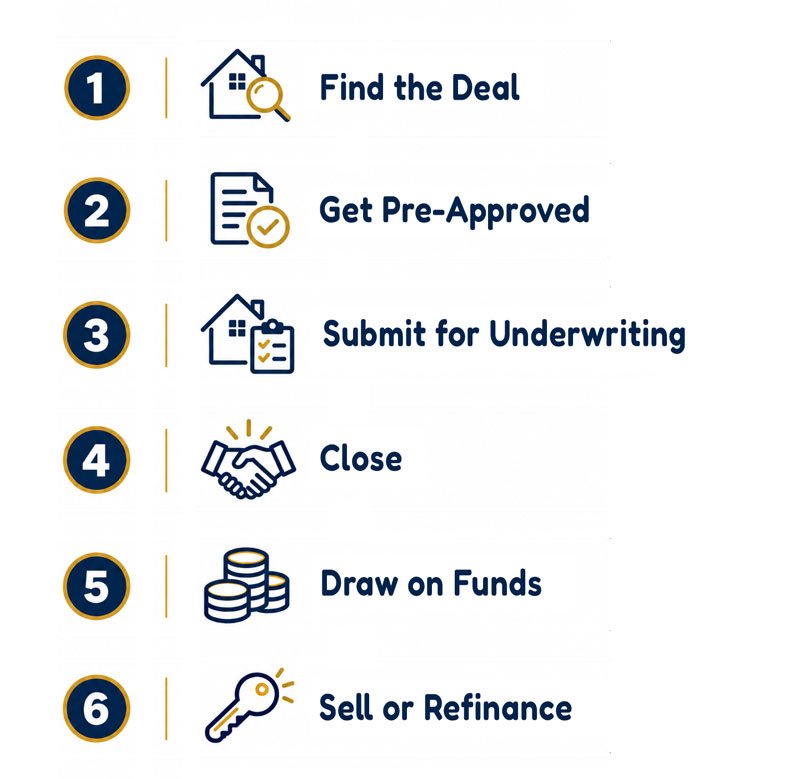
What the Process Actually Looks Like, Start to Finish
Here's roughly how it goes from finding a property to getting funded:
Find the deal. You identify a property and run your numbers, purchase price, rehab budget, and expected resale value.
Get pre-approved. Talk to your lender before you're under contract, not after. This tells you what you can actually afford to offer.
Submit the deal for underwriting. The lender reviews the property, the numbers, and your plan.
Close. With hard money, this can happen in days instead of the weeks a bank would need.
Draw on funds for construction. Rehab costs are typically released in draws as work is completed and inspected, not all at once upfront.
Sell or refinance. Once the project is done, you exit the loan either by selling the property or refinancing into longer-term financing.
None of this requires you to already be an expert. It just requires working with a lender who'll walk you through it instead of handing you a checklist and disappearing.
Quick Answers
Do I need good credit to get a hard money loan? Not in the way you'd need it for a bank mortgage. Credit isn't ignored, but it's not the deciding factor. The property and the deal carry most of the weight.
How is a hard money loan different from a bank loan? Speed and underwriting focus. Hard money closes faster and evaluates the deal itself. Banks are slower and evaluate you as the borrower.
What can hard money actually be used for? Fix and flip, BRRRR, teardowns and ground-up construction, and fast-moving deals like wholetail and short-sale purchases.
Do I need to be an experienced investor to use hard money? No. A lot of first-time investors use hard money specifically because it doesn't require the extensive documentation a bank does.
Thinking about your first deal on Long Island and not sure where to start? Book a call or apply now and we'll walk through what's realistic for you.